
It seems like everyone who owns a truck these days is slapping on a LED light bar. Doesn’t really matter where or how, as long as it looks cool. I’ve seen them anywhere from under the bumper, on the bumper, behind the grille, on the hood, above the front window, on the roof rack. Hell, it seems to be a trend to put them on the back of the vehicle. These lights range anywhere from a 3×3″ pod to a full blow 55″ curved light bar. Some of these locations make perfect sense. On the bumper, super traditional and very practical. Behind the grill, ok, not my thing but will protect the lens with minimal loss of light. On the roof rack, again, very traditional and practical. Above the window, you might experience some noise but it is becoming the norm. Under the bumper…you are an idiot (unless they are rock lights). On the hood… unless they are mounted in the ditch light configuration, mounting a light bar on the thin skin of a hood seems like you are asking for trouble, but hey it’s your truck. Now let me address the lights on the back. I had 2 lights on the back of my last truck and I am plan on adding 2 on the back of my new truck. These offer great lighting while camping, backing up in odd or tight places or in the event of an emergency. Mounting a light bar on the back of your mall crawler for the sake of having yet another cheap eBay light bar on your truck and riding down the road with it on, not cool. I kinda hope you get pulled over by a very pissed-off, state patrolman who is being made to work a shift ’cause the rookie got sick. The placement is up to you, but please be courteous to those around you and make sure you are abiding by the rules and regulations put forth by your state.
On to the main focus of today’s blog. Lighting. Placement is very important, but what I consider more important is what light you choose. There are so many variations of what you can pick up on today’s market, but what you buy and where you buy it can make a huge difference in getting the job done. I have a partial sponsor from KC HiLites and will be using their lights to explain my purpose.
At one time I was running the KC slimlight series. Great light, don’t get me wrong, but after a while it became a little bulky and out of place. It is much harder to aim these and more chance that they will move. They do put out around 2,500 lumens, so they are bright and because they are halogen they work great in the snow and rain.
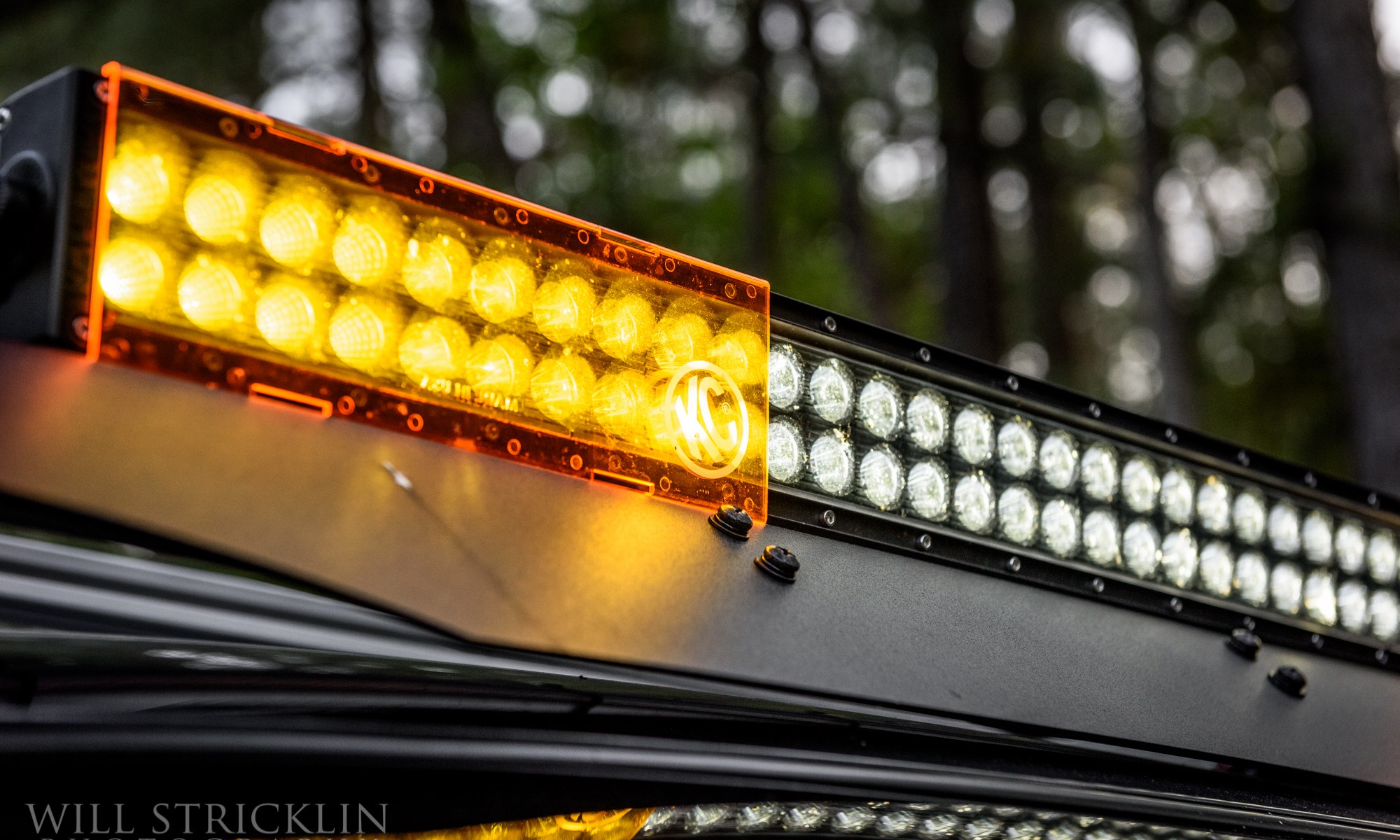
Eventually, I replaced these with the KC C3 3″ cube. I have 4 amber lights mounted across the front, on top of the bumper. These are fanned out in a 90-degree pattern to give the best lighting to the front. On either side of the truck are C3 flood lights to flood the area while camping or when going over harsh terrain in night time conditions. Then comes the big guy. The 40″ straight flood and spot light bar mounted in the Prinsu Roof Rack. This light bar is also equipped with amber covers to do two things, protect the lexan lens and abide by any state laws requiring them to be covered. All these C3 series lights from KC use CREE LEDs and burn at 6000K except for the amber lights.
Ok, so why the amber? Well as some of you know, white LED has little to no ability to “cut through” particles but rather bounces off every particle creating a wall of light effect. I’m not gonna get into scientific specifics as to why this happens, but if you have experienced this, you know what I mean. The orange color, whether by LED or by cover, changes the spectrum and allows you to better see in dust, snow, and rain. Some people have found that mixing Halogen and LED gives them a good mix for just this reason.
Another great thing about LED is the heat output and the amount of power it takes to run them. I can remember leaving my Halogens on with the engine off and in a matter of minutes, they began to drain the battery. LEDs or Light Emitting Diodes, oh yea, that’s what LED stands for, don’t burn gas so they create far less heat and the lowered resistance uses far less energy. The halogen bulb itself can have a hard time functioning in cold weather and is subject to dirt and oil, sometimes causing them to burst.
On average, LEDs outlast halogen bulbs by thousands of hours and as they are more costly to produce they will be more upfront, but will last much longer. Good housings play into how long these bulbs can last. These are rated on the Ingress protection chart, or what shit can get into your light. FIRST OF ALL, if your light doesn’t start off with IP 6, DO NOT BUY IT! Anything less than 6 means it can’t even keep out dust. The next number SHOULD be at least a 5, so IP 65. This means it can take water jets, like washing your car. IP 66 is better, it can take a stronger jet, but IP 67 and 68 is what you are looking for. KC HiLites are IP67 and that means the light can be submerged in 1 meter of water. IP 68 would mean deeper than 1 meter and I think you may be on the wrong blog as you have a submarine and not an overland vehicle.
In all my time owning vehicles and making modifications using lighting, the one thing I have learned that is paramount above all else is, USE QUALITY. I know some of you are on a budget and some of you just can’t afford certain items and I suppose some light is better than no light if you want to make that argument, but reliability is the main factor. If you all you want is the look, then by all means, save some money, buy the cheap Chinese knock off being sold on eBay, hook that bad boy up and crawl the hell out of that local mall. If you are planning on going into some deep dark areas of the world and can’t be sure of the length of time or how rough the road is getting there, please consider saving some money and buying a better product. KC is my obvious choice but there are plenty of other reputable brands that won’t cost as much as a company that starts with an R and ends in IGID.
Best of luck out there! There are a lot of choices, way too many variables, and even more designs and features. Find what best meets your needs, place it in the locations that best help you navigate and keep the wiring clean. Good luck overlanders!
-Will

 DMG Exploration
Some good information to keep in mind as I continue to outfit our Jeep Wrangler Unlimited for overlanding. We are only just going into overlanidng so we are slowly modifiying out vehicle to make it more practicle. The first upgrade was an LED headlight conversion kit which made the Jeep driveable at night. We plan to add two floods and two spot lights on the bumper to keep the light low. I am a big fan of the old round halogen variety.
LikeLike